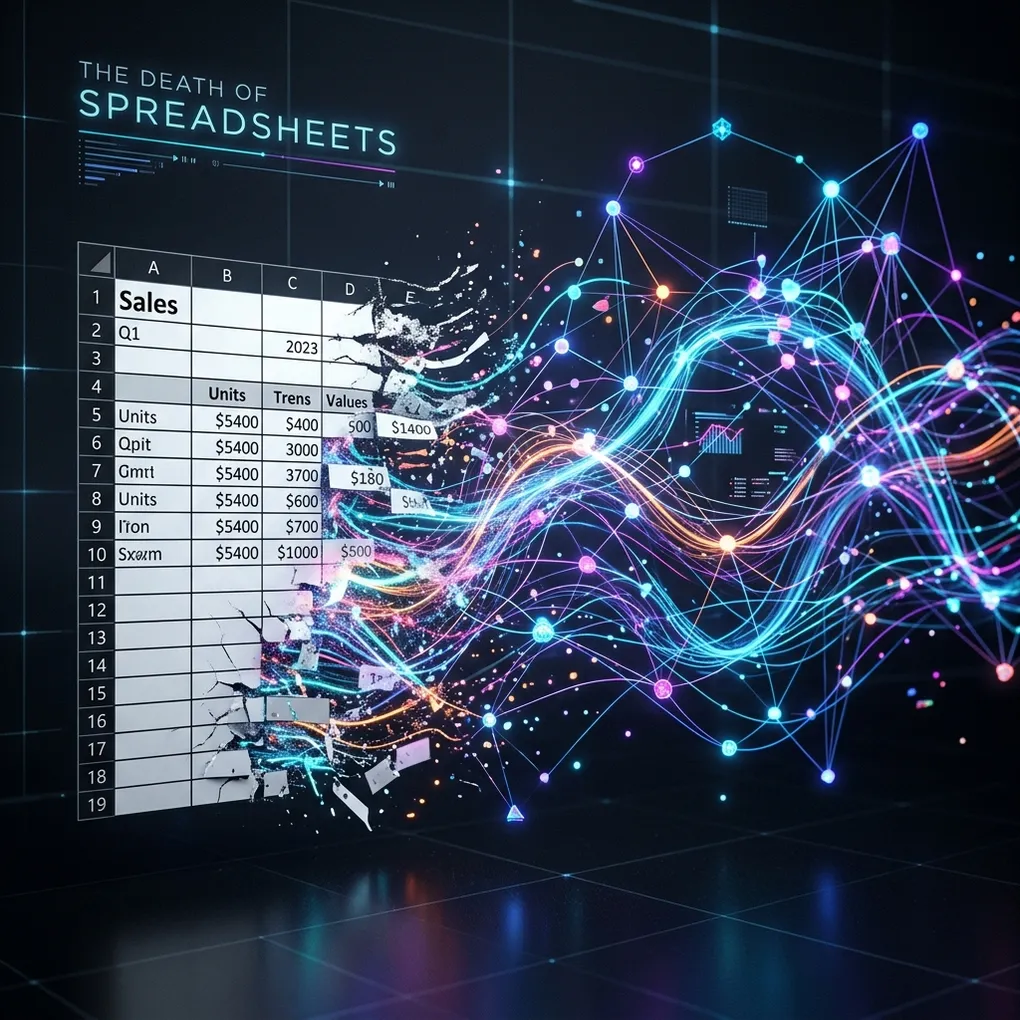
The Death of the Spreadsheet and the Rise of the Context Layer
For over forty years, the spreadsheet has been the undisputed monarch of business computing.
It started around 1983 when Lotus 1-2-3 (following VisiCalc in 1979) began proliferating across corporate offices as desktop computers became cheap enough for businesses to deploy at scale. Suddenly, any professional with a keyboard could build their own custom business software.
But what actually is a spreadsheet?
At its core, a spreadsheet is a structured document that forces three distinct layers of computing to live in the exact same file:
- Ingestion (Data): The raw numbers, text, and inputs typed or imported into cells.
- Transformation & Intelligence (Logic): The formulas, macros, lookups, and scripts that process those inputs.
- Artifact Creation (Presentation): The cell formatting, borders, column widths, font sizes, colors, and charts that make the data readable to human eyes.
By converging these three layers into a single grid, spreadsheets democratized business logic. It was a brilliant compromise for an era of limited computing power.
But it came with a massive structural tax. Because data, logic, and formatting are tightly coupled in the same document, they are incredibly brittle. More importantly, they suffer from a fatal flaw: the compounding accumulation of Ontological Debt.
The Concept of Ontological Debt
Just as software developers accumulate technical debt, business operators pile up ontological debt when they build spreadsheets.
When you design a spreadsheet, you are mapping a highly customized mental model onto a two-dimensional grid of cells. You know exactly what a specific cell means, why a formula references a particular offset, and what assumptions are baked into the layout. The context lives in your brain.
The moment someone else opens that sheet, that context is lost. The spreadsheet becomes an opaque wall of coordinates.
What we have discovered over forty years of spreadsheet design is a simple human truth: the way I view the world and the way you view the world are fundamentally different.
What makes sense to me in a visual spatial arrangement will not make sense to you. When we build a spreadsheet, we are hardcoding our subjective visual worldview to act as a logical backend pipeline. We expect others to decode both our personal spatial layout and our mathematical logic simultaneously. This is why creating a spreadsheet and handing it off to someone else is such a fragile transaction—and why it so rarely works.
Over time, your critical path becomes historically dependent on systems that grow more fragile as the informational and technological environment changes. The spreadsheet doesn’t care about your internal processes, procedures, or changing ideas—it remains frozen in the coordinates of the day it was built.
The Equity Cost of Ontological Debt
Ontological debt isn’t just an operational nuisance; it is a direct tax on your enterprise value.
When an acquirer evaluates a business, they look closely at key-person risk. If your company’s processes, financial tracking, and operational logic are locked inside a spaghetti-maze of custom spreadsheets built by a few key employees, your business is fragile. If those individuals leave or take a vacation, the company’s operating system collapses.
Because of this, companies built on spreadsheet-centric operations trade at lower valuation multiples. An acquirer is buying a black box.
Decoupling your operations—extracting logic from visual cells and codifying it into version-controlled markdown context files and deterministic scripts—translates tribal knowledge into institutional equity. You are no longer selling a collection of fragile spreadsheets; you are selling a repeatable, scalable enterprise asset.
The solution is to decouple the layers entirely.
The Historical Parallel: Decoupling the Stack
This shift is not a random occurrence; it is a recurring law of technological evolution.
The Evolution of the Web
In the early days of the web, we built “spaghetti code.” Database queries (data), business logic (code), and HTML/inline styles (presentation) were commingled in a single PHP file. The web only scaled when we decoupled these concerns: databases for state, APIs for logic, and CSS/JS frameworks for presentation. The spreadsheet is simply the last monolithic silo undergoing this inevitable decoupling.
The Evolution of the Terminal
Think of the history of computing terminals:
- 1950s: Single central mainframe computers. Remote access was primitive, and all processing happened on the central machine.
- 1980s–1990s: The rise of personal computing. The terminal became its own independent processing unit, running local software.
- 2000s–2010s: Web interfaces pulled processing back to cloud servers, using the local terminal as a thin rendering client.
- 2020s: We are abstracting the information within the thoughts and rules of the organization. The terminal is no longer just rendering pixels; it is orchestrating cognitive context.
Ingest
Raw Data, Transcripts, PDFs, APIs
Transform
Probabilistic AI + Deterministic Logic
Output
Bespoke Markdown, PDFs, Dashboards
The Probabilistic-Deterministic Handshake
In a spreadsheet, the formulas themselves are actually deterministic: =A1*B1 is a simple mathematical rule.
The messy, probabilistic, and stochastic layer is the layout itself—the design of how those formulas are arranged in which boxes on which sheets. We have spent forty years hardcoding visual arrangements to act as logical pipelines.
If a cell’s value equals another cell times a number, that is a simplistic deterministic formula. It does not need to be dynamically updated as long as the underlying knowledge layer remains consistent.
By separating these layers, we establish a clean handshake:
- The Probabilistic Layer (AI): Ingests raw, unstructured, messy real-world data and interprets the context and intent.
- The Deterministic Layer (Code): Takes that interpreted intent and runs it through strict, unchanging logic and calculations (e.g., Python scripts).
This is the macro-structural pillar of modern folder-based agent architectures like the Interpretable Context Methodology (ICM). Instead of building a fragile grid, you build a context directory of rules and let the code do the math.
A Ground-Level Case Study: Bookkeeping Cleanup
To see the economic impact of this shift, look at a common business headache: a client who has mixed personal and business funds across multiple bank accounts over several years.
The Legacy Spreadsheet Way
To clean this up, a professional must build a massive, custom Excel workbook. They write nested lookups, add dropdowns, configure macros to sort transactions, and spend hours manually categorizing rows.
- The Cost: It requires weeks of tedious manual labor, costing upwards of $10,000. The client cannot afford it, and the team dreads doing it.
- The Fragility: If a new vendor appears or a bank changes its CSV export format, the formulas break. The ontological debt catches up with you.
The Decoupled Way
Instead of building a spreadsheet, you build a sandboxed AI system and separate the layers:
- Context: You document the client’s individual situation (vendors, family members, bank accounts) in a simple Markdown file.
- Data: You feed in the raw bank statements (unstructured ingestion).
- Logic: You run a pattern-recognition routine (probabilistic AI) that pairs the raw statements with the client’s context, maps them to a set of deterministic rules (Python script), and writes the categorized entries to a clean ledger.
To build the spreadsheet system would take an order of magnitude longer, cost more to operate, and break instantly when new data patterns emerge. The decoupled system handles variations dynamically, scales to multiple years of history in seconds, and costs a fraction of the price.
The Obsoleting of the Spreadsheet Wizard
For years, I was the person coding these complex spreadsheets. I built dynamic lookups, complex data transformations, and custom financial models. I could code with the best of them in Excel.
But I have realized that my own former work is now completely superfluous.
The spreadsheet scratchpad remains a valid tool for ideation and prototyping. If you need to quickly sketch out a mathematical relationship or visual workflow, the grid is a great sandbox.
But once you reach certainty, you must stop operating in the spreadsheet. You must extract the logic and encode it.
The Rise of the Context Architect
This transition is giving rise to a new operational archetype: the Context Architect.
The Context Architect is not a programmer, nor are they a data entry clerk. They are a domain expert who understands the rules of the business and translates those rules into legible, version-controlled markdown files (like an Interpretable Context Protocol) that guide AI engines. They define the intent, set the boundaries, and coordinate with developers to build the deterministic calculation scripts.
In the AI era, your highest leverage as a builder is no longer managing cell coordinates. It is orchestrating context. The builders who realize this first will stop maintaining Excel sheets and start building enterprise engines.